It’s one of the most recognized pieces of packaging on the planet, and most of us have never actually thought about why it looks the way it does or how it holds up carrying a burger, fries, and a toy without falling apart in a kid’s hand.
This piece digs into where the box actually came from, what it’s built out of, how big it really is, and why restaurants, food trucks, and toy brands outside of McDonald’s keep asking packaging companies to build them something in the same spirit.
Where the Happy Meal Box Actually Came From
The Happy Meal box wasn’t dreamed up in a McDonald’s corporate boardroom. It came from a Kansas City ad executive named Bob Bernstein, whose agency had handled McDonald’s advertising in the region since the late 1960s. The story goes that Bernstein noticed his own son sitting at the breakfast table, completely absorbed in reading the back of a cereal box instead of eating. That one observation became the whole idea: what if a fast food Packaging box did the same thing a cereal box did, and kept a kid entertained while they ate?
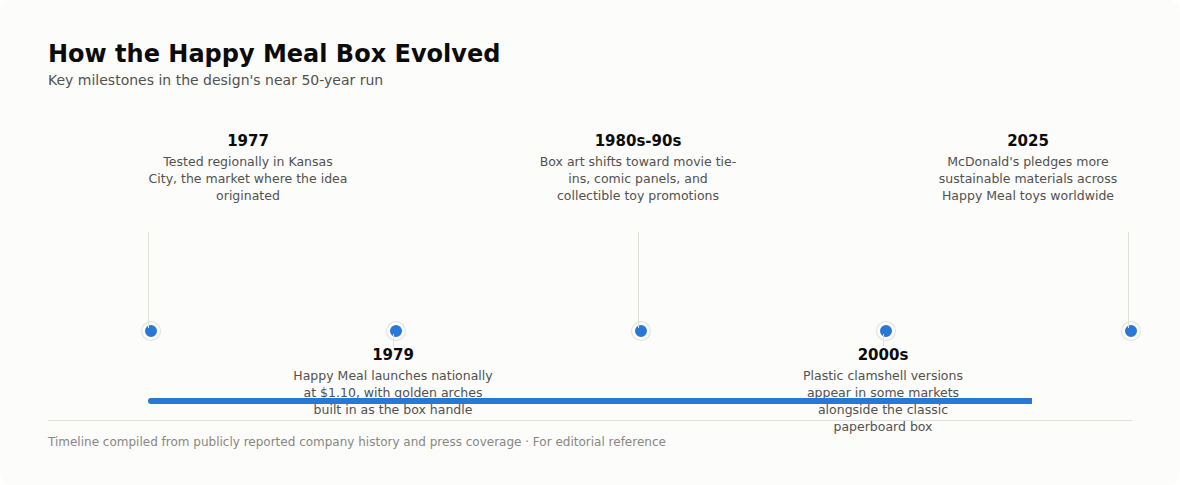
McDonald’s tested the concept in Kansas City in 1977, and it worked well enough that the Happy Meal went national in 1979 at $1.10 a meal. The name itself borrowed from McDonald’s advertising at the time, which was already positioning the brand as “the happy place.” The original box carried the golden arches built right into the packaging as a fold-out carrying handle, and the outer panels were printed with puzzles, riddles, comic strips, and games genuinely something to do at the table, not just a container.
There’s a competitive backstory here too. Burger Chef had already been running its own kids’ combo, the “Fun Meal,” for six years before McDonald’s launched the Happy Meal. When Burger Chef sued over the idea, they lost, because they’d never trademarked it. McDonald’s had. Burger Chef eventually closed or got absorbed by competitors, and the Happy Meal became the version everyone remembers instead.
How Big Is a Happy Meal Box, Really?
If you’ve ever tried to recreate one from memory, the proportions are easy to get wrong. A standard Happy Meal box runs roughly 6 and 7/16 inches wide, 3 and 3/4 inches deep, and 4 inches tall, not counting the handle on top. That’s small enough to fit comfortably in one hand, which is exactly the point it was designed around a kid’s grip from day one, not scaled down from an adult meal box.
Special edition boxes have strayed from that standard over the decades. The old Raggedy Ann and Andy box, for instance, measured closer to 5 by 5 by 6 inches, which tells you the dimensions have never been treated as sacred they flex depending on the promotion, the toy inside, and the printing run.
What the Box Is Actually Made Of
The material is unglamorous but does exactly what it needs to: food-grade paperboard, typically a coated boxboard similar to what you’d find on a cereal box or a cracker carton, printed on the outside and left plain or lightly coated on the inside where it touches food. It’s die-cut from a flat sheet, scored along fold lines, and glued at a couple of seams no separate lid, no plastic clamshell, just one piece of board that folds itself into a box.
That single-piece construction is a big part of why the design has lasted this long. It’s cheap to produce at massive scale, it ships flat before assembly, and it can carry full-color printing on every visible panel without needing a separate label. The plastic version some regions have used over the years works differently usually a molded polypropylene box designed to be reused as a lunchbox or toy container after the food is gone but the paperboard version has always been the default, largely because it’s cheaper and easier to recycle.
Mini Boxes, Regional Versions, and Other Variations
Not every Happy Meal comes in the full-size box. Smaller “mini” versions have shown up over the years for limited promotions, birthday party bundles, and regional menu items, usually just a scaled-down take on the same fold pattern rather than a totally different structure. Color schemes have shifted too the red-dominant version most people picture is the long-running standard, but seasonal and promotional runs have used everything from all-white boxes with minimal print to fully-wrapped designs tied to a movie release or a toy line.
How the Happy Meal box design has evolved since 1977
Why Other Brands Want a Box Like This
Here’s where this stops being just a nostalgia piece. Plenty of restaurants, food trucks, bakeries, and toy or subscription-box companies come to packaging manufacturers asking for something that captures what the Happy Meal box does so well: a container that’s part meal packaging, part entertainment, and instantly recognizable as “the kids’ one” on a menu board or a shelf.
A well-built kids’ meal box does a few jobs at once. It needs to actually hold food safely, which means food-grade board and a fold pattern that won’t sag or leak. It needs a bit of showmanship, whether that’s a printed activity, a cutout window to show off a toy, or just bright, kid-friendly color and character art. And increasingly, it needs to look responsible a lot of parents notice when a kids’ meal comes in an unnecessary plastic clamshell versus a simple printed box, and that perception shows up in repeat business. McDonald’s itself has been moving in this direction, having pledged to shift Happy Meal toys toward more sustainable materials, which says something about where the whole category is heading.
What Goes Into a Custom Happy Meal Style Box
If you’re a restaurant or brand looking to get something built in this spirit, the process looks a lot like what produced the original, just with your own branding instead of golden arches. A few things worth knowing before you request a quote:
Material and stock weight. Most custom kids’ meal boxes are built from food-safe paperboard in the 10pt to 24pt range, sometimes heavier for anything meant to double as a keepsake or toy container. Kraft board is a common eco-friendly choice if you want the “responsible” look built in rather than added on.
The fold-and-handle structure. The reason the classic design works is that it’s a single die-cut piece no separate handle to attach, no lid to lose. A good packaging partner will die-cut this so it folds into shape with the handle built in, the same way the original does.
Printing and finish. Full-color printing (CMYK or Pantone-matched for exact brand colors), plus options like matte or gloss coating, spot UV highlights, or a cutout window if you want the toy or a treat visible before the box is even opened.
Order size. Unlike a lot of custom packaging categories, kids’ meal boxes are often ordered in smaller runs for promotions or seasonal menu items, so it’s worth asking a manufacturer whether they offer low minimums rather than assuming you need a massive print run to get custom printing at all.
How to Make a Happy Meal Box Yourself (the Simple Version)
If you just want to build a Happy Meal style box at home, for a party, a school project, or a fun DIY gift box, you don’t need industrial equipment. Take a piece of medium-weight cardstock or thin cardboard, and cut a cross-shaped template: a square base panel, four side panels that fold up from it, and one panel extended upward with a slot cut near the top edge for a handle. Score the fold lines with the back of a butter knife or a bone folder before you fold, glue or tape the side seam, and fold the handle panel down through itself so the two ends lock together at the top. Decorate the outer panels before you assemble, not after, since it’s much easier to print or draw on a flat sheet than a folded box.
That home version will get you the shape and the fun of it, but it won’t have the strength or finish of an actual food-grade box which is exactly the gap a packaging manufacturer fills when a business wants to do this at scale with real branding on it.
The Takeaway
The Happy Meal box has stuck around for nearly five decades because it never tried to be more complicated than it needed to be: one folded sheet of board, a built-in handle, and just enough printed personality to make a kid want to look at it before they even open it. That same formula is exactly what makes it worth copying, in spirit, for any brand trying to make a kids’ meal or a small giveaway feel like more than just a container. Whether you’re chasing the nostalgia or just the function, the box that started as one guy noticing his kid reading a cereal box is still the template most of the industry quietly builds from.